
How effective is Lianyirong's sales and marketing engine at converting anchor enterprise relationships into scalable SME demand?
Lianyirong's GTM ties anchors, banks, and SMEs via automated credit discovery, boosting conversion through its LDP-GPT model; by March 2026 the firm reported accelerating SaaS mix and improved take-rates, signaling stronger unit economics and durable fee growth.
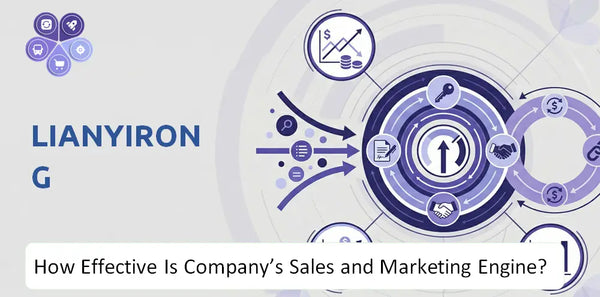
Lianyirong's shift to AI-driven onboarding reduces approval time and increases throughput, improving demand quality and lowering loss rates; investors should watch customer concentration and margin expansion as control points.
Learn more product context: Lianyirong Porter's Five Forces Analysis
Which Customers and Segments Is Lianyirong Trying to Win?
Lianyirong targets large anchor enterprises, financial institutions, and cross-border trade participants, prioritizing high-density ecosystems led by Fortune 500 or top-tier state-owned anchors. The commercial engine focuses on Global 2000 accounts and fast-growth sectors where multi-tier credit transfer and digital trade scale revenue quality.
 Main Customer Group: Tier 1 Anchor Enterprises
Lianyirong pursues Anchor Enterprises – Fortune 500 and top state-owned groups – that act as hubs for thousands of suppliers. Winning one anchor typically unlocks network effects across supplier bases, boosting platform transaction volumes and average revenue per account.
Secondary Targets: Financial Institutions
Financial institutions provide liquidity and buy risk-management and cloud processing modules; they pay higher fees for credit distribution and underwriting tools. Lianyirong targets regional banks and international trade financiers to monetize financing rails and transaction fees.
Positioning: Platform for Multi-Tier Digital Trade
Lianyirong positions itself as a multi-tier, cloud-native trade finance platform that reduces credit friction for complex supply chains. The sales pitch stresses integration with ERP, compliance, and risk-transfer tools to drive adoption among large anchors and their supplier networks.
Economic Rationale: High-Value, Sticky Revenue
Anchors generate concentrated, recurring transaction fees and enable cross-sell to thousands of suppliers, improving lifetime value (LTV). Financial institutions add fee-for-service revenue and lower capital cost per transaction, supporting scalable gross margins.
By 2025 Lianyirong expanded Global 2000 coverage to accelerate cross-border digital trade adoption; documented client wins and platform transaction growth were cited as key drivers in recent coverage such as Growth Outlook Analysis of Lianyirong Company.
Lianyirong SWOT Analysis
- Complete SWOT Breakdown
- Fully Customizable
- Editable in Excel & Word
- Professional Formatting
- Investor-Ready Format

How Does Lianyirong Acquire Demand Efficiently?
Lianyirong acquires demand efficiently via an Anchor-led model and bank partnerships that drive low CAC and fast payback. The firm captures entire supplier ecosystems from single Anchor Enterprises and embeds cloud solutions into bank portals, producing scalable, automated SME onboarding and shorter sales cycles.

Anchor-led Enterprise Distribution
Onboarding one Anchor Enterprise opens access to thousands of suppliers, turning each anchor into a distribution hub. In fiscal 2025 over 65 percent of new SME participants came via these automated ecosystem effects.
Digital Reach and Online Demand
SEO, content, and platform integrations support inbound leads for larger anchors and SMEs; paid acquisition is limited to targeted campaigns. The AI-enhanced cloud stack improved conversion velocity, shortening technical sales cycles by ~30 percent vs 2023.
Sales Channels and Partner Distribution
Strategic partnerships with major global banks embed Lianyirong's solutions into corporate banking portals, using banks' sales forces as outsourced lead generators and broadening reach without proportional marketing spend.
Demand-Generation Tactics
Targeted co-marketing with Anchor Enterprises and banks, plus field enablement and online onboarding campaigns, drive high-quality pipeline. Product-led demos and plug-and-play onboarding reduce cost-to-convert.
Acquisition Efficiency Metrics
Reportable metrics show low CAC relative to LTV driven by anchor cascades and bank distribution; faster deployment cut time-to-revenue and improved payback periods. These factors indicate strong marketing ROI for Lianyirong company in 2025.
Strongest Reach Advantage
The largest scalable advantage is the Anchor-led network effect combined with bank portal integrations, which converts enterprise relationships into thousands of SME sign-ups with minimal incremental marketing spend. See Business Model Analysis of Lianyirong Company for deeper context: Business Model Analysis of Lianyirong Company
Lianyirong PESTLE Analysis
- Covers All 6 PESTLE Categories
- No Research Needed – Save Hours of Work
- Built by Experts, Trusted by Consultants
- Instant Download, Ready to Use
- 100% Editable, Fully Customizable

How Does Lianyirong Convert Demand into Revenue Quality?
Lianyirong converts platform traffic into high-quality revenue through transaction fees plus recurring SaaS subscriptions, with AI-driven premium services increasing take rates and stickiness. Pricing mixes per-transaction charges and tiered SaaS seats; long multi-level financing and cross-sell keep revenue repetitive and high-quality.
Core Sales Model and Route to Close
Lianyirong sells a hybrid model: platform onboarding for anchors, transactional access for supplier flows, and enterprise SaaS for treasury and credit tooling. Sales cycles focus on anchor wins; once an anchor signs, supplier penetration follows via integration hooks and revenue-share routing.
Pricing and Monetization Logic
Pricing blends per-transaction take rates and multi-tier subscriptions for the LDP-GPT AI agent platform, with add-ons for cross-border rails and credit-transfer modules. Contracts favor multi-year commitments with volume discounts and usage-based surcharges for premium risk-profiling and automated documentation.
Conversion and Purchase Drivers
Conversion hinges on measurable ROI: faster receivables, lower fraud, and simplified compliance via LDP-GPT. Proof points include expedited onboarding demos, pilot fee waivers, and integration toolkits that reduce time-to-value under 30 days for top anchors.
Repeat Revenue and Customer Expansion
Upsell levers are cross-border payment modules and multi-tier credit transfers; recurring SaaS seats and usage fees drive expansion. For 2025 Lianyirong reported Net Revenue Retention above 115 percent among core anchor clients, reflecting consistent upsell and reduced churn.

How Lianyirong Converts Demand into Revenue Quality
Lianyirong turns demand into durable, high-quality revenue by combining transaction take rates with sticky SaaS subscriptions and LDP-GPT enhancements that raise ARPU and switching costs; deep-tier financing multiplies lifetime value across supply chains.
- Hybrid sales engine: anchors → supplier network monetization
- Tiered pricing: per-transaction take rates + recurring SaaS
- Strongest driver: LDP-GPT premium services raising conversion and take rates
- Revenue-quality takeaway: Deep-tier financing and > 115% NRR make revenues sticky and repetitive
For a focused market-position read and comparative context see Market Position Analysis of Lianyirong Company
Lianyirong Marketing Mix
- Complete Marketing Mix Analysis
- Effortlessly Communicate Your Business Strategy
- Investor-Ready Format
- 100% Editable and Customizable
- Clear and Structured Layout

What Does Lianyirong Commercial Engine Mean for Future Performance?
The commercial engine positions Lianyirong company sales engine to drive sustained margin expansion through 2026, led by an AI-first operating model and standardized cloud solutions that reduce manual credit processing. Key supports are AI scaling and sector diversification; key weaknesses are geopolitical risk in cross-border trade and execution of automation rollout.
AI-driven Standardization Supports Future Demand
The maturation of the AI agent platform should boost transaction throughput and quality, supporting adoption in emerging-market trade finance where digital transformation is accelerating; this underpins a projected 20 – 25% CAGR in transaction volume for 2025 – 2026 and pushes gross margins toward 65 – 70%.
Channel and Marketing Effectiveness
Digital channels and partnerships in financial institutions appear able to scale customer acquisition cost-efficiently as AI decouples revenue from headcount; marketing ROI for Lianyirong company should improve as automation raises funnel conversion and lowers cost per approved transaction.
Risks to Commercial Performance
Geopolitical volatility can compress cross-border volumes abruptly and raise provisioning; slower-than-expected AI agent scaling or higher integration costs could delay margin expansion and weaken Lianyirong sales performance.
Overall Commercial Outlook
Commercial engine appears cautiously optimistic and adaptable for 2025/2026: AI-driven marketing automation effectiveness review shows potential to drive high-margin growth, but outcomes hinge on execution and geopolitical tailwinds; see this Target Market Analysis of Lianyirong Company for customer and sector detail: Target Market Analysis of Lianyirong Company.
Lianyirong Porter's Five Forces Analysis
- Covers All 5 Competitive Forces in Detail
- Structured for Consultants, Students, and Founders
- 100% Editable in Microsoft Word & Excel
- Instant Digital Download – Use Immediately
- Compatible with Mac & PC – Fully Unlocked

Related Blogs
- How Did Lianyirong Company Develop Into Its Current Investment Case?
- How Does Lianyirong Company Work and What Drives Its Business Model?
- What Do the Mission, Vision, and Core Values of Lianyirong Company Reveal to Investors?
- How Strong Is Lianyirong Company's Competitive Position?
- How Credible Is the Growth Outlook of Lianyirong Company?
- How Attractive Is Lianyirong Company's Customer Base and Target Market?
- Who Owns Lianyirong Company and Who Holds Real Control?
Frequently Asked Questions
Lianyirong targets large anchor enterprises, financial institutions, and cross-border trade participants. Its main focus is on Fortune 500 and top state-owned anchors that can unlock supplier ecosystems, while financial institutions help monetize liquidity, credit distribution, underwriting, and transaction-fee modules.
Disclaimer
All information, articles, and product details provided on this website are for general informational and educational purposes only. We do not claim any ownership over, nor do we intend to infringe upon, any trademarks, copyrights, logos, brand names, or other intellectual property mentioned or depicted on this site. Such intellectual property remains the property of its respective owners, and any references here are made solely for identification or informational purposes, without implying any affiliation, endorsement, or partnership.
We make no representations or warranties, express or implied, regarding the accuracy, completeness, or suitability of any content or products presented. Nothing on this website should be construed as legal, tax, investment, financial, medical, or other professional advice. In addition, no part of this site - including articles or product references - constitutes a solicitation, recommendation, endorsement, advertisement, or offer to buy or sell any securities, franchises, or other financial instruments, particularly in jurisdictions where such activity would be unlawful.
All content is of a general nature and may not address the specific circumstances of any individual or entity. It is not a substitute for professional advice or services. Any actions you take based on the information provided here are strictly at your own risk. You accept full responsibility for any decisions or outcomes arising from your use of this website and agree to release us from any liability in connection with your use of, or reliance upon, the content or products found herein.