
How effective is Honeywell International Inc.'s sales and marketing engine at converting long-cycle industrial demand into recurring revenue?
Honeywell International Inc.'s go-to-market blends high-touch aftermarket selling with software-led subscription motions, supporting over 35 percent of revenue from services and software in 2025 and a backlog above $33 billion in early 2026, signaling durable revenue visibility.
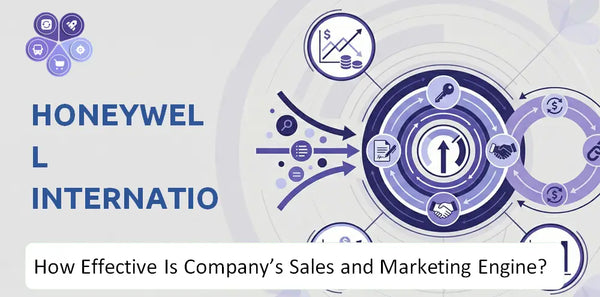
Investors should note the Accelerator system standardizes seller motions, improving conversion quality and margin expansion while concentrating execution risk in long-cycle contracts; monitor backlog conversion rates and software ARR growth.
Honeywell International Porter's Five Forces Analysis
Which Customers and Segments Is Honeywell International Trying to Win?
Honeywell International Inc. targets large aerospace OEMs, defense agencies, commercial real estate owners, and heavy industrial operators focused on decarbonization, prioritizing accounts that buy integrated software, SAF (sustainable aviation fuel) systems, and autonomous robotics rather than commoditized hardware.
 Main customer: Aerospace OEMs & operators
Global aircraft manufacturers such as Boeing and Airbus, plus major airline and MRO operators, drive most Aerospace Technologies revenue. In 2025 Honeywell International Inc. pushes SAF systems and avionics suites to capture higher-margin lifecycle service contracts; aerospace accounted for roughly 36% of adjusted 2025 segment profit mix.
Secondary targets: Real estate & logistics
Commercial real estate developers and large warehouse operators are core for Building Automation and Industrial Automation. Honeywell International Inc. in 2025 prioritized customers needing end-to-end autonomous robotics and integrated building controls to move away from low-margin hardware toward subscription and services revenue.
Market positioning: Integrated tech partner
Honeywell International Inc. positions itself as a systems and software-first vendor – selling integrated technology stacks (controls, analytics, robotics, SAF supply systems) and recurring services. The go-to-market strategy emphasizes bundled solution ARR growth and cross-sell into installed bases to lift Honeywell sales effectiveness and marketing ROI.
Economic rationale: Higher-margin, recurring streams
These segments matter because software, services, and SAF-related contracts increase gross margins and recurring revenue. In 2025 Honeywell International Inc. reported maintenance, repair and overhaul and software-driven services growth outpacing hardware, supporting an implied operating margin expansion of roughly 120 bps year-over-year in targeted segments.
For a deeper corporate context see History Analysis of Honeywell International Company
Honeywell International SWOT Analysis
- Complete SWOT Breakdown
- Fully Customizable
- Editable in Excel & Word
- Professional Formatting
- Investor-Ready Format

How Does Honeywell International Acquire Demand Efficiently?
Honeywell International Inc. acquires demand through a hybrid model: consultative direct sales for aerospace and defense and a digital-first, software-led approach (Honeywell Forge) for building automation and industrial clients, yielding efficient, scalable lead generation and strong channel coverage.

Consultative Platform Sales for Aerospace & Defense
Honeywell sales effectiveness centers on a high-touch, consultative sales force that secures multi-year platform contracts, driving predictable, high-margin backlog and long customer lifecycles.
Digital Reach via Honeywell Forge
Honeywell marketing strategy pivots on Honeywell Forge as a Trojan horse: the SaaS platform identifies operational inefficiencies, creates inbound leads, and scales digital demand using search, paid media, and targeted account-based campaigns.
Field Sales, Partners and Distribution
Sales channels combine direct field teams, channel partners, and system integrators to convert complex B2B deals; distributors and OEM relationships speed deployment in building automation and industrial segments.
Demand-Generation Tactics
Demand-generation uses targeted pilots via Honeywell Forge, industry events, technical workshops, and joint programs with channel partners to demonstrate ROI and shorten sales cycles.
Acquisition Efficiency Metrics
Honeywell sales and marketing performance shows efficiency: SG&A ran near 13% of revenue in fiscal 2025, reflecting tight cost control while funding digital lead-gen and field-selling capacity.
Strongest Reach Advantage
The combination of Honeywell Forge-driven inbound leads and an entrenched global field-sales network gives Honeywell go to market strategy for industrial customers a scalable edge, converting software trials into product and services revenue.
Quantitatively, Honeywell International Inc. reported fiscal 2025 revenue of $37.1 billion, with software and connected solutions growth driving higher-margin services; Forge contributed materially to aftermarket bookings and reduced cost-per-acquisition in building and industrial segments. See further context in this Business Model Analysis of Honeywell International Company
Honeywell International PESTLE Analysis
- Covers All 6 PESTLE Categories
- No Research Needed – Save Hours of Work
- Built by Experts, Trusted by Consultants
- Instant Download, Ready to Use
- 100% Editable, Fully Customizable

How Does Honeywell International Convert Demand into Revenue Quality?
Honeywell International Inc. converts demand into high-quality revenue by prioritizing recurring software subscriptions and long-term service contracts over one-time hardware sales, driving higher margins and steadier cash flow. Pricing is value-based in Aerospace and Performance Materials, and upsells into Honeywell Forge raise lifetime value while cutting churn.
Core sales model: subscription-led and service-first
Sales focus on SaaS subscriptions (Honeywell Forge) and multi-year service agreements; field sales and channel partners close large OEM and aftermarket deals with solution-led demos and ROI cases.
Pricing and monetization logic: value over cost
Honeywell uses value-based pricing to offset inflation, with tiered subscription fees and performance-linked service pricing in Aerospace and Performance Materials supporting margin preservation.
Conversion and purchase drivers: aftermarket and ROI evidence
Aftermarket services and predictive-maintenance subscriptions convert hardware buyers into recurring customers; documented ROI and uptime improvements shorten sales cycles and justify premium pricing.
Repeat revenue and customer expansion: upsell path to Forge
Upselling existing hardware clients into Honeywell Forge and long-term service contracts drives renewals and cross-sell; aftermarket margins run about 10 – 15 percentage points above new-equipment sales.

How Honeywell Converts Demand into Revenue Quality
Honeywell converts demand into durable, high-quality revenue by shifting the mix toward recurring SaaS and long-term services, using value-based pricing to protect margins, and leveraging aftermarket upsell into Honeywell Forge to lift lifetime value.
- Subscription-led and service-first sales model drives predictable revenue
- Value-based pricing in Aerospace and Performance Materials offsets inflationary pressure
- Aftermarket services and Forge upsells are the main conversion and retention drivers
- Segment margins near 24 percent in 2025 reflect higher-margin recurring revenue mix
For more on the target customers and go-to-market segmentation that feed this engine, see Target Market Analysis of Honeywell International Company
Honeywell International Marketing Mix
- Complete Marketing Mix Analysis
- Effortlessly Communicate Your Business Strategy
- Investor-Ready Format
- 100% Editable and Customizable
- Clear and Structured Layout

What Does Honeywell International Commercial Engine Mean for Future Performance?
Honeywell International Inc.'s commercial engine underpins mid-single-digit organic growth through 2026, backed by a $33,000,000,000 backlog and shifts into higher-growth end markets; supply-chain limits in aerospace and integration of recent buys will determine near-term topline quality.
Backlog and Market Pivot Support Future Demand
The $33 billion backlog provides measurable revenue visibility into 2025/2026 and supports Honeywell sales effectiveness as the firm shifts toward software, automation, and electrification markets where pricing and recurring revenue are higher.
Channel and Marketing Effectiveness Appears Sufficient
Existing global channels, CRM investments, and digital go-to-market efforts suggest Honeywell marketing strategy can scale recent cross-sell initiatives; integration of acquired product teams is the gating item for Honeywell sales and marketing performance.
Primary Risks to Commercial Performance
Aerospace supply-chain constraints remain a tactical headwind and could compress revenue timing; failure to realize synergies from acquisitions would weaken marketing ROI Honeywell and reduce EPS upside projected at 8 – 11% in 2025/2026.
Overall Commercial Outlook for 2025/2026
Commercial engine looks strong but conditional: disciplined portfolio pruning and targeted acquisitions bolster the moat, so long as integration lifts sales funnel conversion and regional sales performance analysis shows consistent improvement.
See related ownership analysis here: Ownership and Control of Honeywell International Company
Honeywell International Porter's Five Forces Analysis
- Covers All 5 Competitive Forces in Detail
- Structured for Consultants, Students, and Founders
- 100% Editable in Microsoft Word & Excel
- Instant Digital Download – Use Immediately
- Compatible with Mac & PC – Fully Unlocked

Related Blogs
- How Did Honeywell International Company Develop Into Its Current Investment Case?
- How Does Honeywell International Company Work and What Drives Its Business Model?
- What Do the Mission, Vision, and Core Values of Honeywell International Company Reveal to Investors?
- How Strong Is Honeywell International Company's Competitive Position?
- How Credible Is the Growth Outlook of Honeywell International Company?
- How Attractive Is Honeywell International Company's Customer Base and Target Market?
- Who Owns Honeywell International Company and Who Holds Real Control?
Frequently Asked Questions
Honeywell International is targeting large aerospace OEMs, defense agencies, commercial real estate owners, and heavy industrial operators focused on decarbonization. The company prioritizes accounts that buy integrated software, SAF systems, and autonomous robotics rather than commoditized hardware, because those customers support higher-margin and recurring revenue.
Disclaimer
All information, articles, and product details provided on this website are for general informational and educational purposes only. We do not claim any ownership over, nor do we intend to infringe upon, any trademarks, copyrights, logos, brand names, or other intellectual property mentioned or depicted on this site. Such intellectual property remains the property of its respective owners, and any references here are made solely for identification or informational purposes, without implying any affiliation, endorsement, or partnership.
We make no representations or warranties, express or implied, regarding the accuracy, completeness, or suitability of any content or products presented. Nothing on this website should be construed as legal, tax, investment, financial, medical, or other professional advice. In addition, no part of this site - including articles or product references - constitutes a solicitation, recommendation, endorsement, advertisement, or offer to buy or sell any securities, franchises, or other financial instruments, particularly in jurisdictions where such activity would be unlawful.
All content is of a general nature and may not address the specific circumstances of any individual or entity. It is not a substitute for professional advice or services. Any actions you take based on the information provided here are strictly at your own risk. You accept full responsibility for any decisions or outcomes arising from your use of this website and agree to release us from any liability in connection with your use of, or reliance upon, the content or products found herein.